Dementia Treatment: A Step-by-Step Guide for Families
Dementia doesn’t just affect memory—it slowly changes how a parent recognises faces, manages money, and feels safe in their own home. If you’ve been searching for the best dementia treatment near AIIMS, Delhi, you’re already asking the right question — because the first step to real relief isn’t another prescription; it’s an accurate diagnosis from a qualified neurologist.
In this guide, we’ll break down what dementia really is, its types and warning signs, how it’s diagnosed and treated, and why families across South Delhi trust Dr Aparna Gupta at Neuro Clinic Plus, Safdarjung Enclave — just minutes from AIIMS Delhi — for structured, long-term dementia care.
Understanding Dementia
Dementia describes a decline in memory, thinking, language, or judgement that is severe enough to interfere with daily life. It is not a normal part of ageing — while age is the biggest risk factor, dementia results from underlying changes in the brain, not simply “getting older”.
According to a nationwide study conducted under the Longitudinal Ageing Study in India (LASI), an estimated 7.4% of Indians aged 60 and above live with dementia, translating to roughly 8.8 million people — a number projected to nearly double to close to 17 million by 2036 as the elderly population grows. Globally, the World Health Organization estimates that over 55 million people live with dementia, with nearly 10 million new cases diagnosed every year. These numbers make early evaluation by a qualified dementia specialist in Delhi an urgent public health priority, not an optional step.
Common early symptoms include:
- Repeating questions or forgetting recent conversations
- Misplacing items or getting confused in familiar places
- Difficulty finding the right words
- Withdrawal from social activities or hobbies
- Mood changes, irritability, or apathy
- Trouble managing finances, medication schedules, or routine tasks
As a dementia specialist in Delhi NCR, Dr Aparna Gupta focuses on catching these signals early, distinguishing dementia from treatable conditions like depression, vitamin deficiencies, or thyroid disorders, and building a structured treatment plan for both patients and their carers.
Types of Dementia: A Quick Comparison
Not all dementia is the same. Accurate diagnosis of the type of dementia directly shapes the treatment plan.
Type of Dementia | Typical Cause | Common Early Signs | Approx. Share of Cases |
Alzheimer’s Disease | Abnormal protein build-up (amyloid plaques, tau tangles) | Short-term memory loss, repeating questions | 60–70% |
Vascular Dementia | Reduced blood flow to the brain, often after strokes | Slowed thinking, problems with planning and judgment | 15–20% |
Lewy Body Dementia | Abnormal protein deposits (Lewy bodies) in the brain | Visual hallucinations, fluctuating alertness, movement symptoms | 5–10% |
Frontotemporal Dementia | Degeneration of frontal/temporal brain lobes | Personality change, impulsivity, language difficulty | 5–10% |
Mixed Dementia | Combination of the above (commonly Alzheimer’s + vascular) | Overlapping symptoms of multiple types | Common in older patients |
This is why a dementia treatment near AIIMS Delhi search should lead you to a full neurological work-up — not a one-size-fits-all prescription.
Why "Near AIIMS Delhi" Matters When Choosing a Dementia Specialist
Families searching for dementia treatment near AIIMS, Delhi, are usually looking for two things: proximity for regular follow-up visits and access to a neurologist connected to strong tertiary-care infrastructure. Neuro Clinic Plus, located at B4/18, Safdarjung Enclave, sits just minutes from AIIMS Delhi and is easily reachable from RK Puram, INA, Green Park, Hauz Khas, and South Extension — making it a practical choice for patients who need consistent, long-term dementia management rather than a one-off consultation.
Because Dr. Aparna Gupta also serves as Associate Director of Neurology at ISIC Multispeciality Hospital, patients benefit from a specialist who is equally comfortable managing complex, hospital-level cases and providing the ongoing, relationship-based care that dementia management demands.
Our Treatment Approach at Neuro Clinic Plus
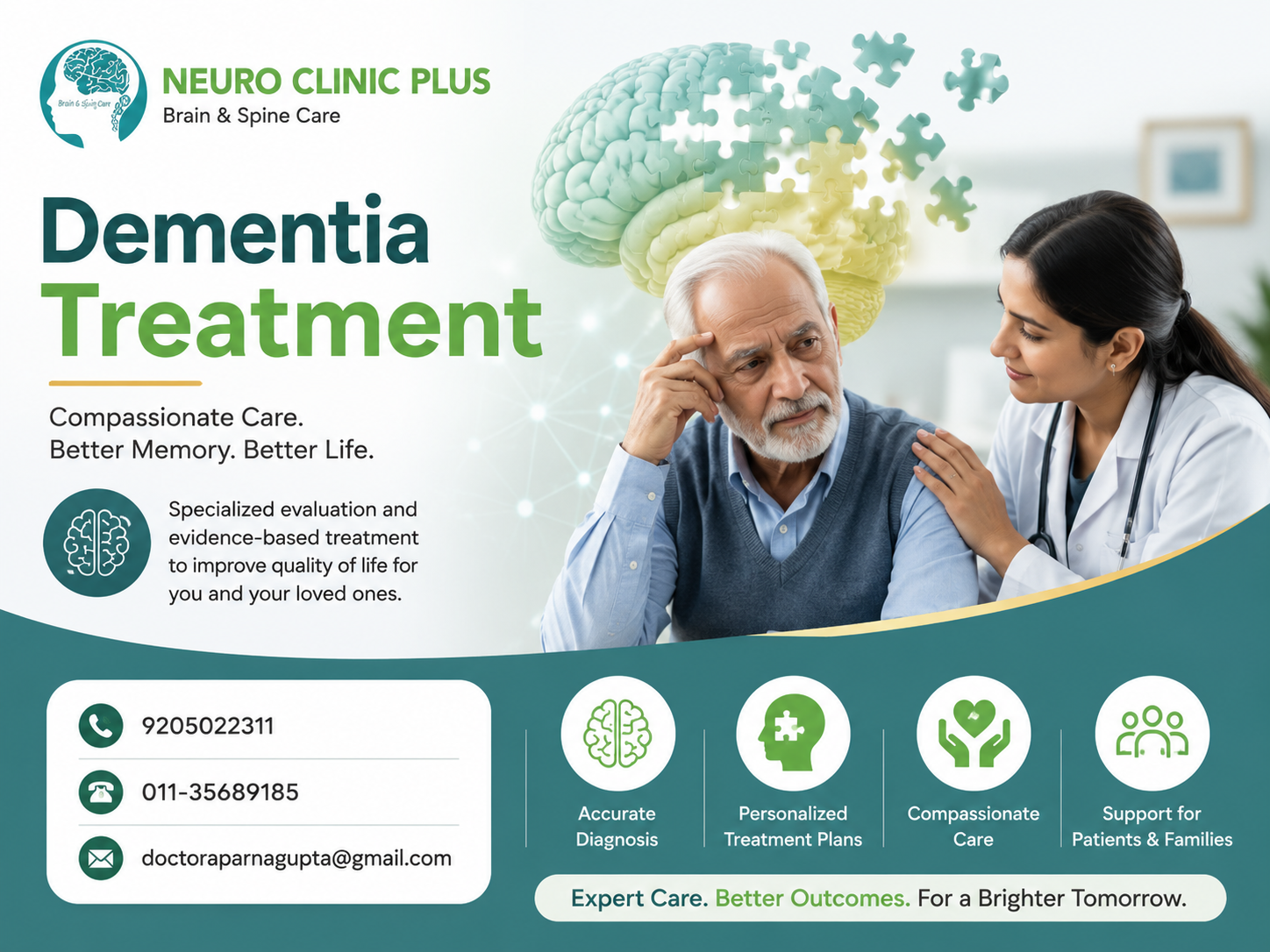
Dementia treatment focuses on two goals: managing symptoms and slowing progression. There is currently no single “cure,” but a well-structured plan meaningfully improves quality of life for both the patient and their family.
At Neuro Clinic Plus, the treatment approach includes:
- Cholinesterase inhibitors and memantine therapy — commonly used medications that support memory and cognitive function
- Cognitive stimulation programs — structured mental exercises designed to maintain thinking skills
- Behavioural symptom management — addressing agitation, sleep disturbance, anxiety, or mood changes
- Caregiver guidance and support — practical coaching for family members managing day-to-day care
- Home environment modification advice — reducing fall risk and confusion through simple changes at home
Every plan begins with a detailed clinical evaluation — history-taking, cognitive assessment, and where needed, imaging — because effective dementia treatment starts with an accurate diagnosis, not a generic prescription.
What Dementia Care Looks Like in Practice
A family from near AIIMS Delhi noticed that a 68-year-old relative was repeating questions, forgetting recent conversations, and becoming withdrawn from activities she once enjoyed. Initially mistaken for “normal ageing,” the symptoms were brought to Neuro Clinic Plus after they began affecting her ability to manage medications safely.
A structured evaluation — history, cognitive testing, and relevant investigations — pointed to early-stage Alzheimer’s disease. Treatment combined a cholinesterase inhibitor, a weekly cognitive stimulation routine, and specific caregiver guidance on structuring the home environment and daily schedule. Over the following months, the family reported steadier day-to-day functioning and, importantly, felt equipped to manage flare-ups in confusion or agitation rather than reacting to them in crisis mode.
This mirrors the core philosophy behind dementia care at Neuro Clinic Plus: diagnosis, medication, structured stimulation, and caregiver support work together — not in isolation.
Neuro Clinic Plus vs. Typical General OPD Care
Factor | Neuro Clinic Plus (Dr. Aparna Gupta) | Typical General OPD / Non-Specialist Care |
Diagnostic depth | Dedicated cognitive and neurological evaluation | Often brief, symptom-only assessment |
Specialist experience | 22+ years in neurology, hospital-level exposure | Variable, often general physicians |
Personalisation | Individualised plan based on dementia type and stage | Standard prescriptions, less tailoring |
Caregiver involvement | Structured caregiver guidance included | Rarely addressed |
Follow-up continuity | Ongoing relationship-based management | Fragmented, episodic visits |
Location for AIIMS-area families | Minutes from AIIMS, Safdarjung Enclave | Depends on hospital assigned |
Behavioural symptom care | Actively managed as part of the plan | Often deprioritised |
This is why patients searching for the best dementia treatment in Delhi near AIIMS specifically look for a neurologist rather than general OPD care — dementia management genuinely benefits from specialist continuity.
Her Story: About Dr. Aparna Gupta
A Trusted Name in Neurology
At Neuro Clinic Plus, patients receive expert and compassionate neurological care from Dr. Aparna Gupta, widely recognised as one of the best neurologists in South Delhi. She serves as Associate Director of Neurology at ISIC Multispeciality Hospital and brings over 22 years of clinical experience diagnosing and treating complex neurological conditions.
At her clinic, Neuro Clinic Plus, patients receive personalised, evidence-based treatment for a wide range of disorders including stroke, epilepsy, chronic headaches, vertigo, Parkinson’s disease, dementia, spine pain, peripheral neuropathy, brain infections, and autoimmune neurological disorders.
Known for her patient-centric approach, accurate diagnosis, and advanced treatment methods, Dr. Aparna Gupta focuses on improving patients’ quality of life through holistic and compassionate care. Her clinic is equipped to provide modern neurological solutions in a comfortable, supportive environment.
- ✓ 22+ years of clinical experience in neurology
- ✓ Associate Director of Neurology, ISIC Multispeciality Hospital
- ✓ Treated thousands of patients across India and abroad
- ✓ Known for patience, empathy, and clear communication
What Patients and Caregivers Value
Families managing dementia often say the hardest part isn’t just the medication schedule — it’s understanding what’s happening and feeling supported through it. Patients and caregivers consistently point to a few things they value most at Neuro Clinic Plus: clear, jargon-free explanations of the diagnosis; realistic expectations about what treatment can and can’t do; and practical, day-to-day guidance for handling behavioural changes at home. That combination of clinical rigour and genuine patience is why many families continue returning for long-term dementia management rather than seeking a second opinion elsewhere.
Frequently Asked Questions
- What is dementia?
Dementia is a decline in memory, thinking, and reasoning severe enough to interfere with daily life, caused by underlying changes in the brain rather than normal ageing.
- Is dementia the same as Alzheimer’s disease?
No. Alzheimer’s is the most common type of dementia, accounting for roughly 60–70% of cases, but dementia also includes vascular, Lewy body, and frontotemporal types.
- Where can I find dementia treatment near AIIMS Delhi?
Neuro Clinic Plus, run by Dr. Aparna Gupta, is located in Safdarjung Enclave, a few minutes from AIIMS Delhi, offering full diagnostic and ongoing dementia care.
- What are the earliest signs of dementia?
Repeating questions, misplacing items, word-finding difficulty, withdrawal from social activities, and trouble managing routine tasks are common early signs.
- Can dementia be cured?
There is currently no cure, but medication, cognitive stimulation, and structured caregiver support can meaningfully slow progression and improve quality of life.
- What medications are used for dementia?
Cholinesterase inhibitors and memantine are the most commonly prescribed medications to support memory and cognitive function.
- How is dementia diagnosed?
Diagnosis involves a detailed clinical history, cognitive assessment, and often brain imaging to identify the type and stage of dementia.
- At what age does dementia usually start?
Dementia is most common after age 65, though early-onset cases can occur in people in their 40s and 50s.
- Is dementia hereditary?
Family history can increase risk, particularly for certain types like early-onset Alzheimer’s, but most cases are not directly inherited.
- What’s the difference between normal forgetfulness and dementia?
Occasionally forgetting names is normal; dementia involves progressive memory loss that disrupts daily functioning and worsens over time.
- Can lifestyle changes help prevent dementia?
Regular physical activity, social engagement, cognitive stimulation, and managing blood pressure and diabetes can help reduce risk.
- What is cognitive stimulation therapy?
It’s a structured program of mental exercises and activities designed to help maintain thinking skills and slow cognitive decline.
- How common is dementia in India?
A nationwide study estimates that 7.4% of Indians aged 60+ live with dementia — around 8.8 million people, a figure expected to nearly double by 2036.
- Is dementia more common in men or women?
Studies show dementia prevalence is somewhat higher among women, partly due to longer life expectancy.
- What is vascular dementia?
A type of dementia caused by reduced blood flow to the brain, often following strokes, leading to slowed thinking and planning difficulties.
Conclusion
Dementia can be frightening for both patients and families — but an early, accurate diagnosis and a structured treatment plan change the trajectory significantly. For families searching for dementia treatment near AIIMS Delhi, Neuro Clinic Plus offers the combination that matters most: specialist neurological expertise, a location that supports consistent follow-up, and a genuinely caregiver-inclusive approach to care.
With over 22 years of experience and a role as Associate Director of Neurology at ISIC Multispeciality Hospital, Dr. Aparna Gupta brings both hospital-level expertise and the patience of a long-term family neurologist. If you’re noticing early signs of memory or cognitive change in a loved one, don’t wait for the picture to become clearer on its own — book a consultation at Neuro Clinic Plus, Safdarjung Enclave, near AIIMS Delhi, today.