
Parkinson’s disease does not always begin with an obvious shaking hand. In many people, the first changes are subtle — walking may become slower, handwriting may get smaller, one arm may stop swinging naturally, or everyday movements may start taking a little longer.
recognize the early signs of Parkinson’s can be important because timely neurological evaluation helps clarify whether the symptoms are related to Parkinson’s disease or another condition affecting movement.
Parkinson’s is a progressive neurological disorder that mainly affects brain pathways involved in movement. It is associated with changes in dopamine-producing nerve cells, which can gradually affect how smoothly and automatically the body moves. Symptoms usually develop slowly and can vary considerably from one person to another.
Importantly, having one symptom does not automatically mean that a person has Parkinson’s disease. Diagnosis requires a careful medical history and neurological examination.
What Are the Early Signs of Parkinson’s?
The early signs of Parkinson’s may be easy to overlook because they can initially appear mild or be mistaken for normal agreeing, fatigue or stiffness.
Some people notice movement-related changes first, while others experience non-movement symptoms before a clear tremor or walking difficulty develops.
Resting Tremor
One of the most recognize symptoms is a Parkinson’s tremor. It commonly begins in a hand, finger or sometimes another part of the body.
A characteristic feature is that the shaking may be more noticeable when the affected limb is relaxed rather than actively being used. Symptoms may initially affect one side of the body more than the other.
However, tremor alone is not enough to diagnose Parkinson’s, and not every person with Parkinson’s develops a prominent tremor.
Slowness of Movement
Slowness of movement is called brassiness and is one of the most important features neurologists evaluate when Parkinson’s is suspected.
A person may notice that:
- Walking has become slower.
- Getting out of a chair takes longer.
- Dressing or buttoning clothes feels more difficult.
- Everyday hand movements become less fluid.
- One arm swings less while walking.
- Turning in bed becomes more difficult.
These changes may gradually interfere with normal daily activities.
Muscle Stiffness or Rigidity
Persistent stiffness in the arms, shoulders, neck or legs can be another early symptom.
Unlike ordinary stiffness after exercise or prolonged sitting, Parkinsonism rigidity may occur without an obvious reason and may restrict natural movement.
Some patients initially interpret this as a joint, muscle or orthopedic problem before neurological assessment identifies an underlying movement disorder.
Changes in Walking and Posture
Movement changes can sometimes be noticed by family members before the individual becomes aware of them.
Possible changes include shorter steps, reduced arm swing or difficulty initiating movement. A person may also appear slightly stooped.
Significant balance problems or frequent falls very early in the course require careful assessment because other neurological conditions can sometimes produce Parkinson-like symptoms.
Smaller Handwriting
Another subtle change is progressively smaller or more crowded handwriting, medically known as xerographic.
Someone who previously wrote in a normal size may find that their letters gradually become smaller toward the end of a sentence.
On its own, handwriting change does not confirm Parkinson’s, but when combined with slowness, stiffness or tremor, it may be worth discussing with a neurologist.
Changes in Facial Expression and Voice
Parkinson’s can affect small automatic movements that people normally perform without thinking.
The face may appear less expressive because facial movements and blinking can decrease. Friends or relatives may notice that the person looks serious even when their mood has not changed.
Speech may also become:
- Softer
- Less expressive
- More monotonous
- Difficult for others to hear
These changes may develop gradually.
Loss of Smell, Sleep Problems and Constipation
Not every symptom of Parkinson’s involves movement.
Possible non-motor symptoms can include reduced sense of smell, constipation, sleep disturbances and changes in mood. Some people experience these symptoms before noticeable motor problems appear.
These conditions are common in the general population as well, so they should not be treated as proof of Parkinson’s disease.
Parkinson’s Tremor vs Other Tremors
Not every shaking movement is caused by Parkinson’s. Essential tremor and other neurological or medical conditions can also cause tremor.
| Feature | Parkinson’s Tremor | Other Common Tremors |
| When noticeable | Often more apparent while the limb is resting | May be more noticeable during activity |
| Beginning | Frequently starts on one side | Can affect both sides |
| Other symptoms | May occur with slowness and rigidity | May occur without Parkinsonian movement changes |
| Diagnosis | Requires neurological evaluation | Cause depends on history and examination |
This comparison is only general guidance. A neurologist should assess persistent or unexplained tremor because several conditions can produce similar symptoms.
Parkinson’s Disease and Other Movement Disorders
Parkinson’s belongs to a broader group of neurological conditions known as movement disorders.
These disorders may cause tremor, stiffness, involuntary movements, abnormal posture or problems with movement coordination.
Because several conditions can resemble Parkinson’s, diagnosis should not be based on symptoms found through an online checklist alone.
A neurological assessment helps distinguish Parkinson’s disease from essential tremor, medication-related symptoms and other forms of parkinsonism.
How Is Parkinson’s Disease Diagnosed?
There is currently no single routine blood test or brain scan that independently confirms Parkinson’s disease in every patient.
Diagnosis is primarily clinical, meaning that a neurologist evaluates the patient’s medical history, symptom pattern and neurological examination.
Medical History
The neurologist may ask:
- When did the symptoms first appear?
- Did they begin on one side?
- Has movement gradually become slower?
- Is shaking present during rest?
- Are there sleep, smell or bowel changes?
- Which medicines is the patient taking?
- Is there a family history of neurological disease?
The progression and combination of symptoms can provide important diagnostic clues.
Neurological Examination
The neurologist may evaluate walking, balance, muscle tone, hand movements, facial expression and coordination.
Bradykinesia is an especially important clinical feature. Parkinson’s Foundation guidance notes that brassiness together with other characteristic findings such as resting tremor or rigidity plays an important role when Parkinson’s disease is being considered.
Are MRI or Other Tests Required?
An MRI does not directly prove that someone has Parkinson’s disease.
However, MRI, blood tests or specialized imaging may sometimes be recommended when the neurologist wants to exclude other conditions or clarify an uncertain diagnosis.
A DaTscan may be useful in selected situations, but it is not required for every patient.
When Should You See a Neurologist?
Occasional shaking or stiffness does not necessarily indicate Parkinson’s. However, medical evaluation may be appropriate when symptoms are persistent, worsening or appearing together.
Consider seeing a neurologist for Parkinson’s Delhi evaluation if you or a family member develops a combination of:
- Unexplained resting tremor
- Increasing slowness
- Persistent stiffness
- Reduced arm swing while walking
- Smaller handwriting
- Noticeable voice changes
- Difficulty performing routine movements
- Multiple unexplained movement changes
Early consultation can help identify the actual cause rather than assuming that every tremor is Parkinson’s.
Parkinson’s Treatment: What Happens After Diagnosis?
There is currently no cure for Parkinson’s disease, but treatment can help manage symptoms and support day-to-day functioning.
Parkinson’s treatment is individualized because symptoms, age, lifestyle and disease progression differ among patients.
Management may include:
- Medicines that improve movement-related symptoms
- Regular exercise and physiotherapy
- Speech therapy when voice or swallowing is affected
- Occupational therapy for daily activities
- Management of sleep, mood and other non-motor symptoms
- Advanced therapies or surgical options in appropriately selected patients
Regular follow-up is important because treatment requirements may change as symptoms evolve.
Why Early Neurological Assessment Matters
There is no need to panic after noticing one possible symptom.
The greater concern is when several unexplained changes gradually develop together — for example, a resting tremor accompanied by slower walking, stiffness and reduced arm movement.
A neurologist can evaluate these symptoms in context and decide whether they represent Parkinson’s disease, another movement disorder or an unrelated medical condition.
Early assessment also gives patients and their families time to understand the condition, discuss treatment choices and establish a long-term care plan.
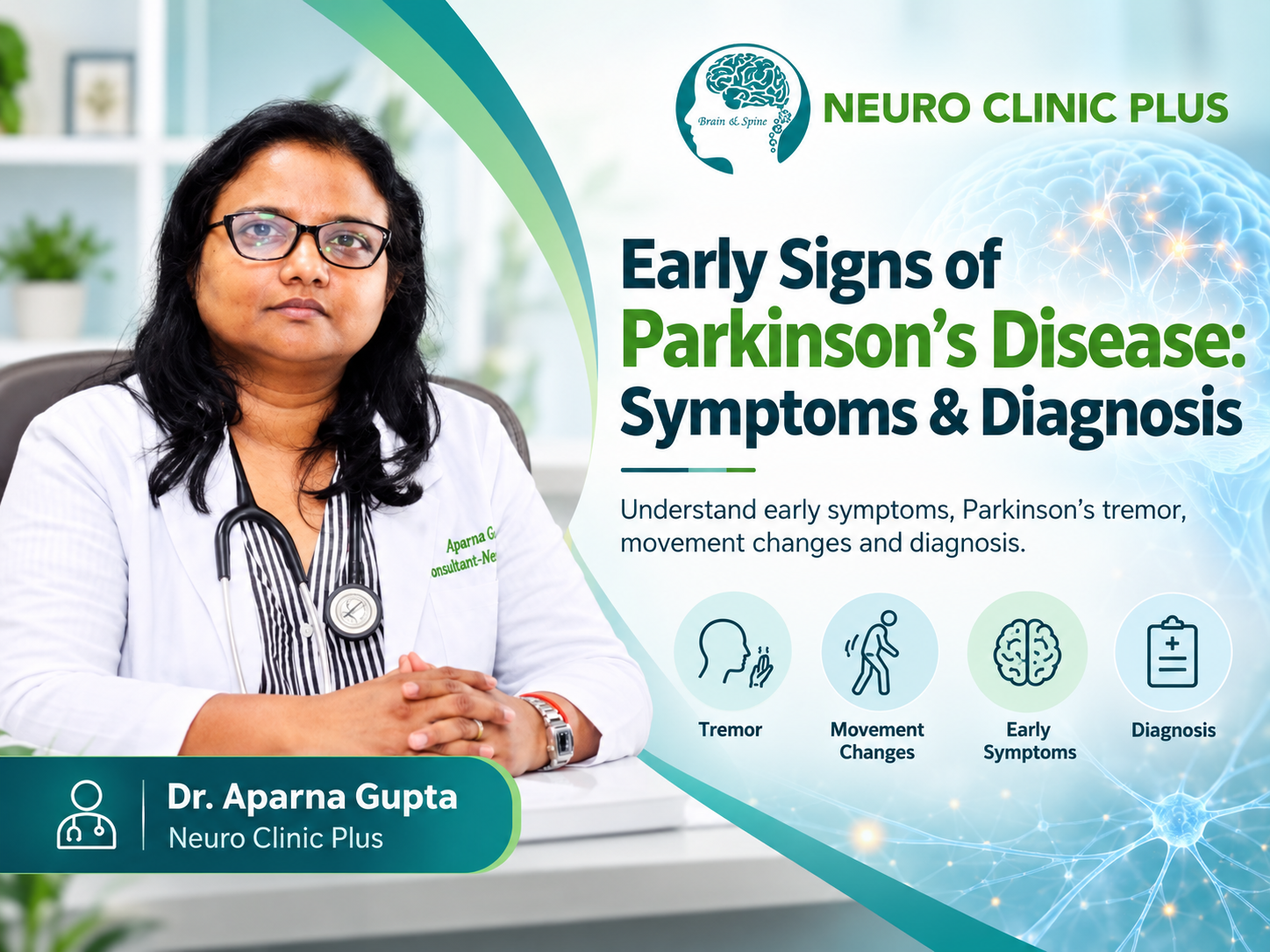
About Dr. Aparna Gupta
Dr. Aparna Gupta is a neurologist with MBBS, MD (Medicine) and DNB (Neurology) qualifications and more than 22 years of clinical experience. She serves as Director, Neurology at ISIC Multispeciality Hospital and consults at Neuro Clinic Plus, Safdarjung Enclave, New Delhi.
Her areas of clinical care include Parkinson’s disease and other movement disorders, stroke, epilepsy, migraine and chronic headache, vertigo, dementia, multiple sclerosis, neuropathy, brain infections and autoimmune neurological disorders.
Dr. Gupta’s DNB Neurology training was completed at Sir Ganga Ram Hospital, New Delhi, and she is a member of professional organisations including the Movement Disorder Society of India, Indian Academy of Neurology, Indian Epilepsy Society and American Academy of Neurology.
Frequently Asked Questions
1. What are the earliest symptoms of Parkinson’s disease?
The earliest symptoms can include mild resting tremor, slower movement, stiffness, reduced arm swing, smaller handwriting, softer speech and changes in smell or sleep. Symptoms vary between individuals.
2. Is hand shaking always a sign of Parkinson’s?
No. Tremor has many possible causes. Essential tremor, medicines, anxiety and other neurological conditions can also cause shaking. Persistent tremor should be medically evaluated.
3. What does a Parkinson’s tremor feel like?
It often appears as rhythmic shaking when the affected hand or limb is relaxed. It may initially be more noticeable on one side of the body.
4. Can Parkinson’s begin without tremor?
Yes. Some people mainly develop slowness, stiffness or other movement difficulties rather than a prominent tremor. Tremor is not present in every patient.
5. At what age does Parkinson’s usually begin?
Parkinson’s becomes more common with increasing age, although younger people can also develop the condition. Age alone cannot confirm or exclude a diagnosis.
6. How does a neurologist diagnose Parkinson’s disease?
Diagnosis is mainly based on medical history, symptoms and neurological examination. There is no single routine test that conclusively diagnoses Parkinson’s in every patient.
7. Can an MRI detect Parkinson’s?
An MRI generally does not directly confirm Parkinson’s disease. It may instead be used to investigate other possible causes of similar neurological symptoms.
8. What are movement disorders?
Movement disorders are neurological conditions affecting the speed, control, coordination or quality of movement. Parkinson’s disease is one type of movement disorder.
9. Is loss of smell associated with Parkinson’s?
Reduced sense of smell can occur in Parkinson’s and may precede motor symptoms in some people. However, smell loss has many other causes and is not diagnostic by itself.
10. Can Parkinson’s disease be treated?
Yes. Although there is currently no cure, Parkinson’s treatment can help control symptoms and support mobility, independence and quality of life.
11. When should I consult a neurologist for Parkinson’s symptoms?
Consider neurological evaluation if persistent tremor, slowness, rigidity, handwriting changes or unexplained movement difficulties develop, particularly when several symptoms occur together.
12. Where can I consult a neurologist for Parkinson’s in Delhi?
Patients seeking a neurologist for Parkinson’s Delhi can consult Dr. Aparna Gupta at Neuro Clinic Plus, Safdarjung Enclave, New Delhi, for neurological assessment and management of Parkinson’s disease and other movement disorders.
Conclusion
recognize the early signs of Parkinson’s does not mean trying to diagnose the condition at home. Tremor, stiffness, slower movement, handwriting changes and non-motor symptoms can have several possible explanations.
What matters is recognising a persistent pattern.
When multiple symptoms develop gradually or begin affecting normal activities, a neurological evaluation can help determine their actual cause. Parkinson’s diagnosis is largely based on clinical assessment, and treatment can then be personalised according to the patient’s symptoms and daily needs.
If you or a family member is experiencing unexplained tremor, increasing stiffness or changes in movement, consulting a neurologist can be an appropriate next step rather than waiting for symptoms to become more pronounced.