
Parkinson’s disease can develop gradually, and its early signs may be easy to overlook. A slight tremor, slower movement, muscle stiffness or a change in walking may initially seem like normal ageing or everyday tiredness. However, persistent or unexplained changes in movement should not be ignored.
Parkinson’s disease is a neurological disorder that mainly affects movement, although it can also be associated with non-motor symptoms. Not everyone with a tremor or movement problem has Parkinson’s disease, which is why proper neurological evaluation is important.
Lorem ipsum dolor sit amet, consectetur adipiscing elit. Ut elit tellus, luctus nec ullamcorper mattis, pulvinar dapibus leo.
Add Your Heading Text HereWhat Are the Early Signs of Parkinson’s Disease?
The early symptoms of Parkinson’s disease can vary from person to person. Common movement-related signs include:
- Tremor, particularly when the body part is at rest
- Slower movements
- Muscle stiffness or rigidity
- Changes in walking
- Reduced arm movement while walking
- Changes in handwriting
- Softer or slower speech
- Changes in facial expression
- Balance or posture-related difficulties
Some people may notice one symptom initially, while others may experience several changes over time.
1. Tremor or Shaking at Rest
A resting tremor is one of the symptoms commonly associated with Parkinson’s disease. It may begin in one hand or another part of the body and can become more noticeable when the affected area is relaxed.
However, not every tremor means Parkinson’s disease. Tremors can have several causes, so persistent shaking should be assessed rather than self-diagnosed.
2. Slower Movements
Another important symptom is bradykinesia, which means slowness of movement.
A person may gradually notice that routine activities take longer than before. Walking, getting dressed, getting up from a chair or performing other everyday movements may become slower.
When this change persists or occurs together with other neurological symptoms, a medical evaluation may be appropriate.
3. Muscle Stiffness
Parkinson’s disease may cause rigidity or stiffness in the muscles.
The stiffness can affect the arms, legs, neck or other parts of the body. Some people may feel that their movements are becoming less flexible or more difficult.
Persistent stiffness has many possible causes, so it needs to be considered together with the person’s other symptoms.
4. Changes in Walking or Balance
Changes in walking can sometimes become noticeable gradually.
A person may develop shorter steps, reduced arm swing or difficulty with certain movements. Balance difficulties can also occur, particularly as the condition progresses.
A new or worsening change in walking should be discussed with a healthcare professional, especially when it occurs alongside tremor, stiffness or slowed movement.
5. Changes in Handwriting
A noticeable change in handwriting can sometimes occur in Parkinson’s disease. Writing may become smaller or more cramped than it was previously.
Handwriting changes alone do not establish a diagnosis, but they can provide useful information during a neurological assessment.
6. Changes in Speech or Facial Expression
Some people may notice that their voice has become softer or that speaking requires more effort.
Reduced facial expression may also occur because of changes in automatic movements.
These changes can develop gradually, and sometimes family members notice them before the person does.
Parkinson’s Disease Can Also Cause Non-Motor Symptoms
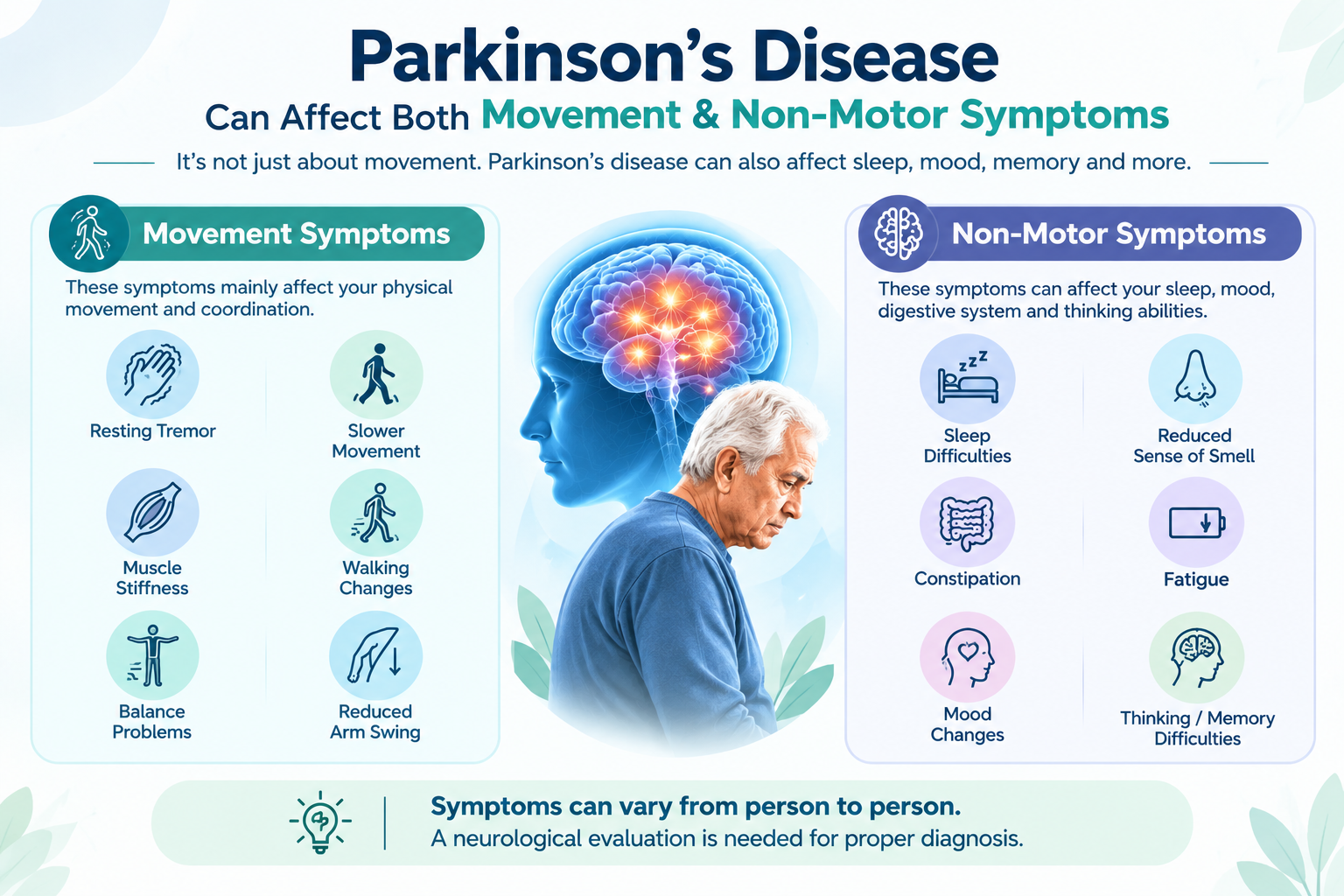
Parkinson’s disease is not limited to movement-related symptoms.
Some people may also experience:
- Sleep difficulties
- Changes in sense of smell
- Constipation
- Fatigue
- Mood changes
- Thinking or memory difficulties
These symptoms can occur in many other medical conditions, so they should not be interpreted as proof of Parkinson’s disease.
Parkinson’s Symptoms vs Normal Ageing: What Is the Difference?
Some changes in movement, sleep, memory or physical activity can happen with ageing. However, a persistent, progressive or unexplained change that starts affecting everyday activities deserves medical attention.
For example, occasional stiffness after physical activity is different from persistent rigidity accompanied by slowed movement. Similarly, an occasional tremor does not automatically indicate Parkinson’s disease.
The important point is not to diagnose Parkinson’s disease based on one symptom. A neurologist considers the complete pattern of symptoms, medical history and examination findings.
Who Should Consider a Parkinson’s Evaluation?
A neurological evaluation may be appropriate for someone who develops persistent or unexplained:
- Resting tremor
- Slowed movements
- Muscle stiffness
- Changes in walking
- Balance difficulties
- Reduced arm movement
- Changes in handwriting
- Speech changes
- A combination of several movement-related symptoms
A consultation can also be useful when symptoms are gradually becoming more noticeable or beginning to interfere with work, mobility or everyday activities.
When Should You See a Neurologist?
Consider speaking with a neurologist when a movement-related change is persistent, unexplained or gradually affecting everyday activities.
A consultation can be particularly relevant when symptoms such as tremor, stiffness, slowed movement, walking changes or balance problems occur together.
The purpose of an evaluation is not simply to look for Parkinson’s disease. A neurologist can also consider other possible causes of similar symptoms.
How Is Parkinson’s Disease Diagnosed?
There is no single test that independently confirms every case of Parkinson’s disease.
Diagnosis generally involves a detailed medical history and neurological examination. Depending on the individual situation, additional investigations may be recommended to rule out other conditions or support the clinical assessment.
This is why online symptom searches should not replace an in-person medical evaluation.
For reliable background information about Parkinson’s disease, symptoms and diagnosis, readers can also refer to the National Institute of Neurological Disorders and Stroke (NINDS).
What Happens During a Neurological Evaluation?
During a neurological consultation, the doctor may ask about:
- When the symptoms first appeared
- Whether symptoms are changing over time
- Whether one side of the body is affected more than the other
- Changes in walking or balance
- Tremor and movement patterns
- Sleep and other non-motor symptoms
- Current medicines and medical history
- How symptoms are affecting everyday activities
The neurological examination may include assessment of movement, muscle tone, coordination, reflexes, walking and balance.
Further investigations may be recommended when clinically appropriate, particularly when another condition needs to be considered.
Is Parkinson’s Disease Treatable?
There is currently no established cure for Parkinson’s disease, but treatment can help manage symptoms and support daily functioning.
Treatment is individualized and may involve different approaches depending on the person’s symptoms and overall health.
Medicines
Doctors may prescribe medicines to help manage movement-related symptoms. The choice of medicine and dose depends on the individual patient and should be determined by the treating healthcare professional.
Physical Therapy and Exercise
Physical therapy, appropriate exercise and rehabilitation may help support mobility, flexibility, strength, balance and everyday functioning.
The type and intensity of activity should be appropriate for the individual’s condition.
Speech and Occupational Therapy
Some people may develop changes in speech, swallowing or the ability to perform everyday activities. Speech therapy or occupational therapy may form part of multidisciplinary care when appropriate.
Advanced Treatment Options
For selected patients whose symptoms are not adequately controlled with medication, advanced treatment approaches such as deep brain stimulation may be considered after specialist assessment.
Treatment suitability varies from person to person.
When Can Parkinson’s Symptoms Require Urgent Medical Attention?
Parkinson’s disease itself is generally a gradually progressive neurological condition, but sudden neurological symptoms should not be assumed to be Parkinson’s disease.
Sudden facial weakness, sudden weakness or numbness on one side, sudden difficulty speaking, sudden confusion, sudden loss of balance or a sudden severe neurological change can be signs of a medical emergency such as stroke.
Such symptoms require urgent medical attention rather than waiting for a routine neurology appointment.
About Dr. Aparna Gupta and NeuroClinicPlus
Dr. Aparna Gupta is a neurologist with 22 years of experience in neurology. She is an Associate Director of Neurology at ISIC Multispeciality Hospital, Vasant Kunj, New Delhi, and also runs her personal neurological practice, NeuroClinicPlus, in Safdarjung Enclave, South Delhi.
Her clinical areas include a wide range of neurological conditions, including Parkinson’s disease and other movement disorders, epilepsy, stroke, headache and migraine, vertigo, dementia, peripheral neuropathy, spine-related neurological problems, brain infections and autoimmune neurological disorders.
Dr. Aparna Gupta’s Qualifications
Dr. Aparna Gupta completed:
- MBBS from Netaji Subhash Chandra Bose Medical College, Jabalpur, in 1998
- MD in General Medicine from Gandhi Medical College, Bhopal, in 2003
- DNB in Neurology from the National Board of Examination, with training at Sir Ganga Ram Hospital, in 2010
- Fellowship in Epilepsy and Sleep Disorders from AIIMS
- Fellowship training in Botox treatment for neurological disorders in Seoul, South Korea
Her professional experience also includes work at the Indian Spinal Injury Centre and senior residency experience in the Department of Cardiology at Sir Ganga Ram Hospital.
Her academic and professional background also includes participation in neurological conferences and research presentations and publications related to neurological conditions.
Parkinson’s Disorder Treatment in South Delhi
If you or a family member has persistent tremor, stiffness, slowed movement, walking difficulties or other unexplained neurological symptoms, professional evaluation can help determine the possible cause.
For information about neurological evaluation and Parkinson’s Disorder Treatment in South Delhi, visit the dedicated Parkinson’s disorder treatment page at NeuroClinicPlus.
Frequently Asked Questions
Is every hand tremor a sign of Parkinson’s disease?
No. Tremor can occur because of several different conditions. A neurological assessment is needed to determine the possible cause.
What is one of the early movement symptoms of Parkinson’s disease?
Tremor, slowed movement and muscle stiffness are among the symptoms commonly associated with Parkinson’s disease. Symptoms can vary between individuals.
Can Parkinson’s disease affect more than movement?
Yes. Parkinson’s disease can also be associated with symptoms involving sleep, smell, bowel function, mood, fatigue and cognitive function.
How is Parkinson’s disease diagnosed?
Diagnosis generally involves medical history and neurological examination. Additional tests may be recommended when needed to consider other possible causes.
When should I consult a neurologist?
If a neurological symptom is persistent, unexplained or gradually affecting daily activities, it is reasonable to discuss it with a qualified healthcare professional.
Can Parkinson’s disease be cured?
There is currently no established cure, but treatment can help manage symptoms and support day-to-day functioning.
Can Parkinson’s disease symptoms be different from one person to another?
Yes. Parkinson’s disease can present differently between individuals, and both movement-related and non-motor symptoms may occur.
Should I diagnose Parkinson’s disease based on symptoms found online?
No. Online information can help you understand possible symptoms, but it cannot establish a diagnosis. Persistent or concerning symptoms should be evaluated by a qualified healthcare professional.